The World Cup came and went. Conventions come and go. A downtown ballpark is coming. The one asset Kansas City owns outright—that no other American city can copy, and that works 365 nights a year—is jazz.
The Spike and the Baseline
This summer, the world came to Kansas City: six World Cup matches, the home base for four national teams, more than 650,000 fans, and FIFA projecting $620 to $650 million in regional economic activity.
If you love this city, you loved every minute of it. The streets were packed, the hotels were full, and the global cameras were rolling.
But in economic terms, the World Cup was a spike.
To get that spike, the region spent years lobbying, subsidizing, organizing temporary logistics, and competing for attention. And then, in July, the final whistle blew. The national teams packed their gear and flew home. The international media broke down their broadcast booths.
Do you know what was playing the night before the first kickoff, the night after the final match left town, and what is playing tonight? Do you know what will be playing on a freezing Tuesday in February when no international tournament or major convention is in town?
Jazz.
In municipal economics, there is a fundamental difference between renting attention and owning brand equity. Mega-events rent attention. They are episodic sugar rushes that require massive public-private capital outlays to secure, only to vanish the moment the closing ceremonies end. A true city brand, on the other hand, is the baseline. It is the permanent, proprietary asset that defines a city’s identity when the tents are folded up.
For Kansas City, that baseline is live jazz. Yet we consistently fund the spikes like vital infrastructure, while treating our permanent baseline like a free public utility that will somehow run forever on nostalgia and air.
Tourism Is a $4 Billion Business. Jazz Is Why We Aren’t Interchangeable.
Look at the hard numbers from Visit KC: visitors spent $4 billion in the Kansas City region in 2025. That translates to roughly $10.8 million walking through the doors of local businesses every single day, generating $280.5 million in local sales tax receipts. Conventions alone drove nearly 470 distinct events, bringing in more than 610,000 visitors and booking over 550,000 hotel room nights worth $477 million in economic impact.
Those numbers are the lifeblood of our hospitality sector. Now ask the uncomfortable question every convention bureau director in America stays awake thinking about: Why here?
Every tier-two midwestern and southern city—Indianapolis, Columbus, Louisville, Oklahoma City, Charlotte, St. Louis—bids for those exact same 470 conventions. Every single one of those cities has a glass-and-steel convention center. Every one of them has a shiny new headquarters hotel with a lobby bar, a steakhouse within walking distance, and a tax-incentive package to dangle in front of site-selection committees. On a spreadsheet from 8:00 a.m. to 5:00 p.m., convention cities are almost completely interchangeable commodities.
The tiebreaker happens at 9:00 p.m.
Only one city in the United States can walk a convention delegate out of Bartle Hall or the Loews Hotel at 9:00 p.m., put her into an intimate room three blocks away where an entire American musical language was forged, and tell her truthfully: You cannot hear this sound, in the place it was invented, anywhere else on Earth.
In urban economics, that is called a place-based monopoly. You cannot build it with TIF bonds, and a rival city cannot outspend us to steal it. In November 2017, Kansas City became the first—and remains the only—UNESCO Creative City of Music in the United States. Indianapolis cannot pass a bond issue to become the birthplace of Charlie Parker. Columbus cannot hire a consultant to manufacture the legacy of Count Basie.
That global designation can only be inherited, and it can only be kept alive on the bandstand.
The Ballpark Needs the Band
Right now, the civic conversation is dominated by the next massive capital project: a roughly 34,000-seat Royals ballpark anchoring a $3 billion, 85-acre Crown Center entertainment district, backed by $600 million in city TIF bonds. With groundbreaking targeted for 2027 and opening day planned for 2030, the pitch promises 20,000 construction jobs and $1.4 billion in projected tax revenue through 2059.
Those are projections, and as taxpayers, we should hold every single one of them to rigorous account.
But let’s assume for a moment that every projection hits the mark. Let’s look at the math of a Major League Baseball calendar. A baseball season has 81 home games. Out of a 365-day year, that leaves 284 days and nights when the stadium lights are off and the turnstiles are locked. Even on the 81 days the Royals are in town, a baseball game takes less than three hours.
What fills an 85-acre, $3 billion district on the 284 nights a year the Royals aren’t playing? What keeps 34,000 fans in the district for two hours before first pitch and three hours after the final out, spending money on food, drinks, and retail instead of walking straight to their cars and driving back to the suburbs?
Live culture. Specifically, live music.
When other cities build stadium districts, they end up importing sterile, corporatized entertainment templates—chain sports bars and Astroturf plazas that look identical whether you are in Atlanta, Dallas, or Cincinnati. Kansas City doesn’t have to import a manufactured vibe to keep a $3 billion district alive at night. We invented the music. The ballpark doesn’t rescue downtown’s nighttime economy on its own; the ballpark district needs the band to survive those 284 off-days.
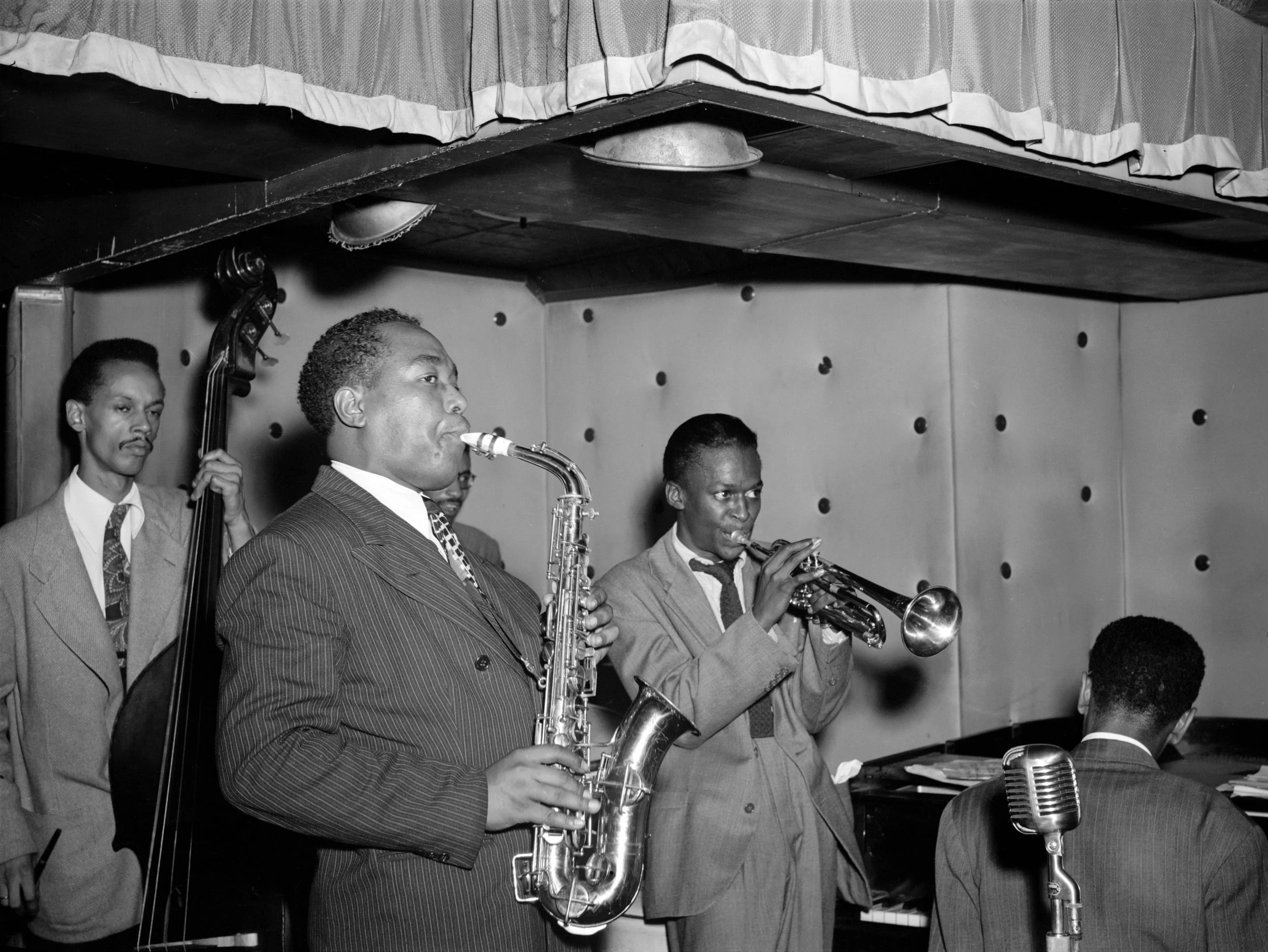
Charlie Parker (left) with Tommy Potter, Miles Davis, Duke Jordan and Max Roach, New York, 1947. Parker was born and raised in Kansas City — the sound he carried to the world was formed here. Photo: William P. Gottlieb / Library of Congress, public domain.
We’ve Run This Economy Before
Treating jazz as an economic engine isn’t a romantic theory. Kansas City has already run this exact economic model at scale, and it built the modern identity of the city.
In the 1930s, Kansas City operated more than 100 nightclubs, dance halls, and vaudeville houses. There were nearly 50 jazz clubs clustered around 12th Street alone, and dozens more anchored around 18th & Vine running all night long. When Bennie Moten, Count Basie, Walter Page’s Blue Devils, Jay McShann, Mary Lou Williams, and Big Joe Turner were tearing the roof off the Reno Club, the Sunset, and the Subway Club, they weren’t performing “charity arts programming.” They were the primary workforce of a booming nocturnal economy.
Look closer at how 18th & Vine actually functioned in its heyday. Because of segregation, the Vine operated as a self-contained, high-velocity economic ecosystem. A patron didn’t just pay a cover charge at a club; they bought suits at local clothiers, ate at late-night barbecue joints and restaurants, stayed in Black-owned hotels, hired local cab companies, and supported local barbershops and printers. Those dollars circulated multiple times inside the very community that created the music. Culture wasn’t pretty decoration painted onto the side of the economy. Culture was the economy.
Earlier this year, the city committed $3.2 million toward the American Jazz Museum’s first major renovation in 25 years. That investment matters. Our history deserves world-class curation, and the museum is a vital anchor.
But a museum cannot take a solo tonight.
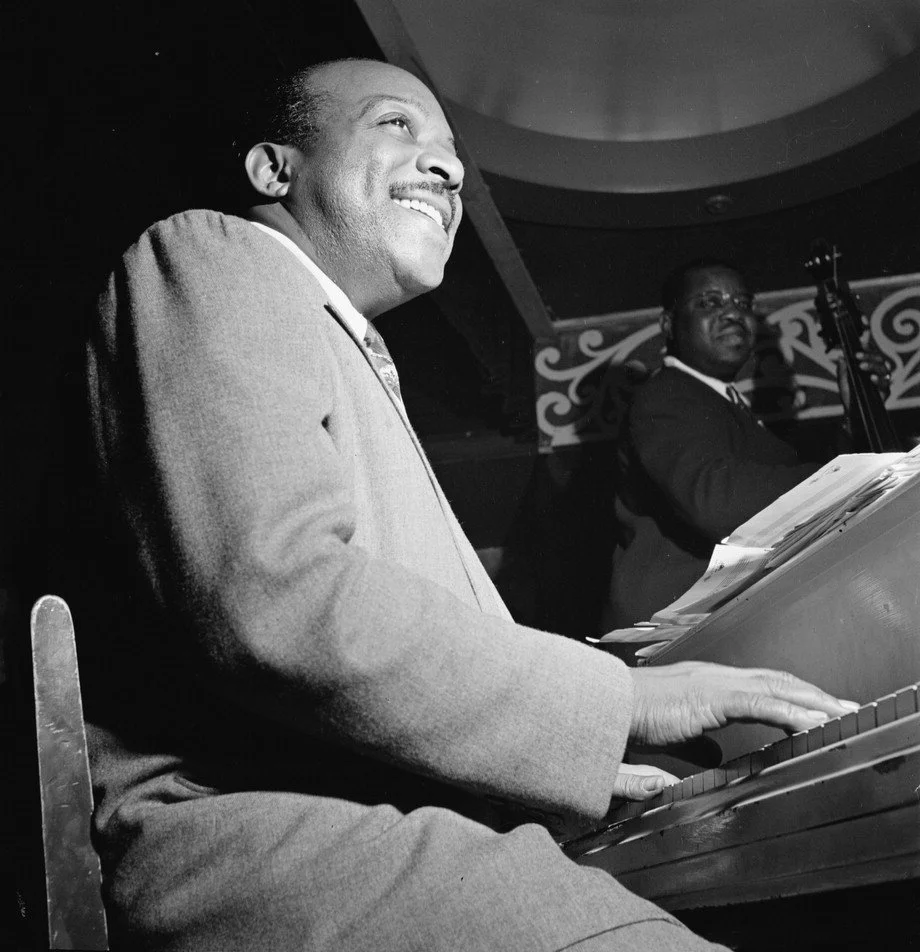
Count Basie at the piano, c. 1946. Basie came up through Bennie Moten’s Kansas City Orchestra and Walter Page’s Blue Devils before taking Kansas City swing to the world. Photo: William P. Gottlieb / Library of Congress, public domain.
A glass display case cannot swing a rhythm section at 11:30 p.m. on a Friday when a group of corporate executives wants to experience the real Kansas City. Preservation keeps the past safe behind velvet ropes. Only living musicians, independent venues, dedicated teachers, and hungry young students can produce the future. When a city spends millions on monuments to dead musicians while letting the market conditions for living ones deteriorate, it isn’t curating a culture—it’s preparing an obituary.
The National Math—and the Local Warning
If you think live music is a niche hobby, look at the macroeconomic data. U.S. music tourism generated $65 billion in 2025 and is projected to nearly double to $126 billion by 2033. According to the National Independent Venue Association (NIVA) landmark national economic study, independent venues and festivals alone generated $153.1 billion in total economic output in 2024, contributing $86.2 billion directly to GDP, sustaining 908,000 jobs, and driving $10.62 billion in direct visitor spending.
Every dollar spent on a ticket at an independent music venue generates an massive ripple effect in neighboring restaurants, hotels, rideshares, and retail.
Now read the single most terrifying statistic from that exact same study: In 2024, 64% of independent stages across the United States were not profitable.
Pause and absorb that disconnect. The macro-asset is worth $153 billion to the broader economy, yet nearly two-thirds of the small businesses that actually produce the product are losing money.
Anyone who has ever run a club or booked a band in Kansas City knows why. The unit economics of presenting live jazz are brutal. Commercial rents, liquor liability insurance, property taxes, and labor costs have skyrocketed over the last decade. Meanwhile, the typical club owner is trying to pay a four- or five-piece band out of bar margins and modest cover charges, and the working musician on that stage is often playing for the exact same $75 to $150 guarantee that players were making in 1985.
The hotels capture the $477 million in room nights. The city captures the $280.5 million in sales tax. The developers capture the TIF subsidies. And the independent jazz venue and the working quartet—the very people creating the authentic Kansas City experience that sold the trip in the first place—are left absorbing the risk on a razor’s edge.
A city never loses its most valuable brand all at once in a dramatic crash. It loses it one quiet club closing at a time. It loses it when a brilliant 26-year-old tenor player realizes he can’t pay his rent gigging in Kansas City and moves to New York or quits music to sell real estate.
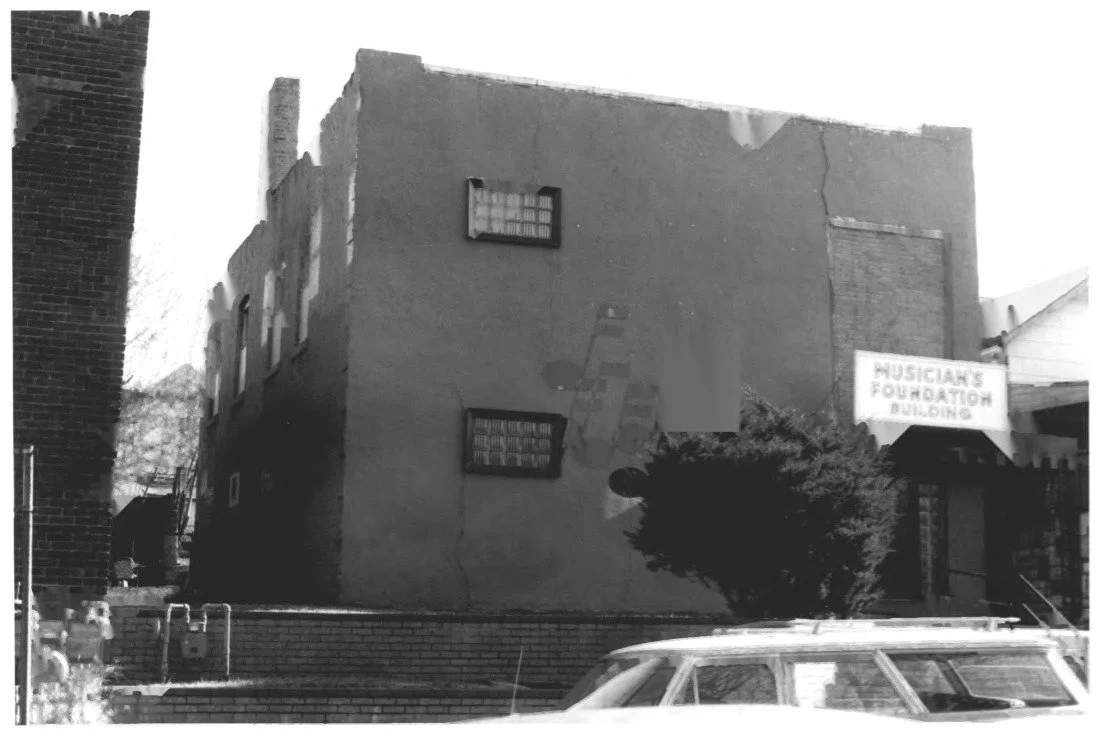
The Mutual Musicians Foundation building, 1823 Highland Avenue, in 1977. Home of Local 627 since 1917, its after-hours sessions helped create the Kansas City sound — and musicians still gather there today. Photo: Sherry Piland, Kansas City Landmarks Commission, National Register file / NPS, no known restrictions.
So Who Holds the Ecosystem Together?
Look at the institutional map of Kansas City today:
The American Jazz Museum preserves the heritage.
Independent venues take the nightly financial risk to present the music.
Local universities, high school band directors, and the Kansas City Jazz Orchestra (KCJO) educate and perform on the concert stage.
Visit KC markets the city to the world.
Every one of those institutions is necessary. None of them, however, are built to be the daily connective tissue.
A thriving cultural economy lives or dies in the connections—the micro-transactions of information and opportunity. A high school rhythm section player who needs a real mentor and a stage. A club owner in Midtown or the Crossroads who needs to fill 60 seats on a Wednesday night. A visiting heart surgeon leaving a convention at 8:45 p.m. who pulls out an iPhone and needs to know, in 30 seconds or less, where the real music is happening right now.
If that visitor searches Google and finds broken links, outdated Facebook pages, or fragmented listings, she stays in the hotel bar. The venue loses a customer, the musicians play to an empty room, and Kansas City loses its differentiation.
Right now, that daily connective infrastructure is built and maintained by LiveJazzKC—operating with zero municipal funding and no major corporate underwriting:
The Only Complete 365-Day Jazz Calendar in Kansas City: A centralized, real-time public utility tracking every live jazz performance across the metro, every single night of the year, paired with comprehensive venue and musician directories and an open Submit Event portal.
Daily Market Promotion: Continuous daily and weekly editorial and social media coverage that acts as a free marketing agency for dozens of local venues and hundreds of working players.
The Pipeline (Workforce R&D): The LiveJazzKC High School All-Star Big Band, now in its fifth year, bringing together the elite young jazz musicians from across the metro under professional mentorship—at zero tuition and zero cost to the students.
An economic ecosystem worth billions in city brand equity should not depend on a 501(c)(3) non-profit holding the digital and educational grid together out of sheer grit.
What Supporting the Brand Actually Looks Like
If we are serious about treating jazz as Kansas City’s signature brand rather than a nostalgic talking point on a city brochure, our habits have to change—from the C-suite down to the street level.
If you are a citizen or music lover: Go out tonight. Not just once a year during a summer festival—go on a Tuesday or a Thursday. Pay the cover charge gladly, buy two drinks, tip the band heavily, and bring an out-of-town guest or a coworker who claims they “don’t know much about jazz.”
If you are a musician or venue owner: List every single gig on the central calendar. When the entire scene aggregates its data in one place, the tide rises for every room in town.
If you are a corporate leader, developer, hotelier, or civic policymaker: Ask yourself a simple business question: Does my company profit when Kansas City feels vibrant, magnetic, and alive at night? If you are recruiting out-of-state executives, filling hotel rooms, leasing luxury apartments downtown, or asking taxpayers for $600 million in stadium bonds, you are free-riding on the cultural cool that working musicians build every night. Stop treating jazz as a $500 honorarium for a ribbon-cutting ceremony. Sponsor the digital infrastructure that puts audiences in seats. Underwrite the High School All-Star Big Band.
Investing in a 17-year-old saxophonist or trumpet player today isn’t charity. It is workforce development and R&D for our signature industry. The student sitting in the All-Star Big Band rehearsal this afternoon is the bandleader a convention delegate will pay to hear in that $3 billion ballpark district ten years from now.
Our generation didn’t earn the Kansas City jazz brand. We didn’t put in the 14-hour nights on 12th Street in 1936 to invent swing and bebop. We inherited a global monopoly for free.
The only question left on the table is whether we are smart enough to invest in the infrastructure that hands it on alive and swinging—or whether we let it wither into a story we tell on historic plaques outside a ballpark, in a city that used to have jazz.
Tonight, the band is still counting off. Find your seat: livejazzkc.com/calendar